Most architectural trim and moldings (including baseboards, crown molding, applied wall moldings, shiplap, beadboard, picture rail, wainscotting, board & batten, chair rail, and plate rail) tend to be painted white.
White seems to "go" with everything, which is why it is so popular.
Here are a few other interior designer inspired paint color options for you to consider for the architectural trim & moldings in your home.
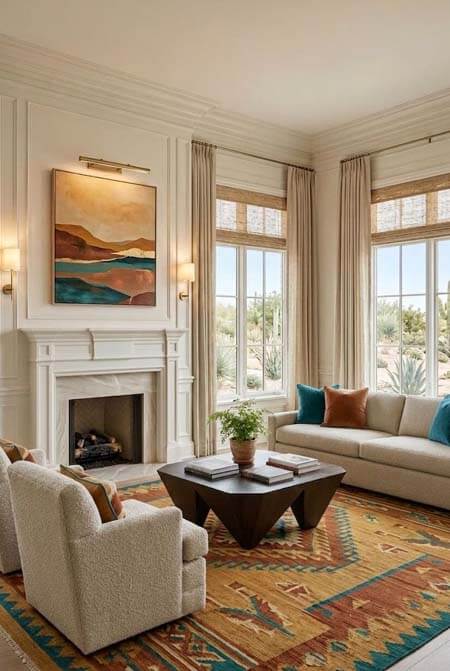 White living room with earth toned accents - AI-assisted image | Human-editedOff White, Cream, or Beige
Bright white trim seems to be the most common color, which is why it looks the most basic.
If you don't care for bright white trim or millwork, consider using an off white, ivory, or cream color for your architectural trim and moldings.
Off white and cream colors are softer and not as harsh as bright white, but still a classic option that you can use in every room of your home.
If you prefer more color on your millwork, you might want to try beige or tan colors.
Beige and tan molding is often used in neutral colored rooms with white walls to add a bit of interest to the molding without it looking overpowering like a darker color might be.
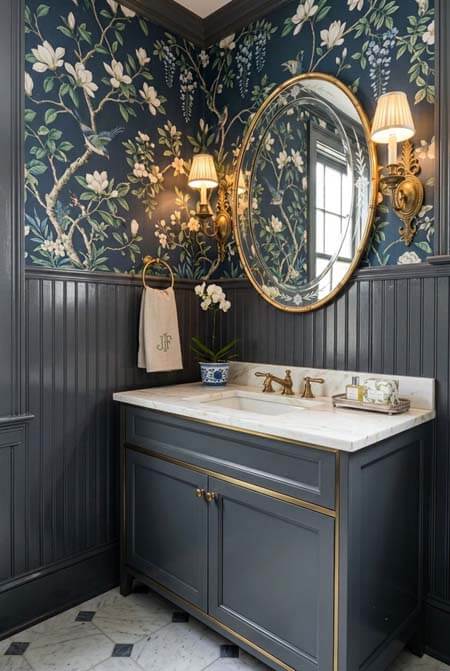 Charcoal gray bathroom vanity and trim - AI-assisted image | Human-editedGray
If beige, white, or cream does not appeal to you for a trim color, but you still want to keep a calming neutral color scheme, consider using gray as your trim color.
Gray also works as a trim color in rooms that are painted colors other than white.
Since gray is a neutral color, it works with most color schemes but is not the basic white that everyone has seen before.
You might choose a light gray if you want your trim color to be just slightly darker than white, choose a medium gray if you want a neutral trim color that has a little more interest, or choose a darker charcoal gray if you want a trim color with more drama.
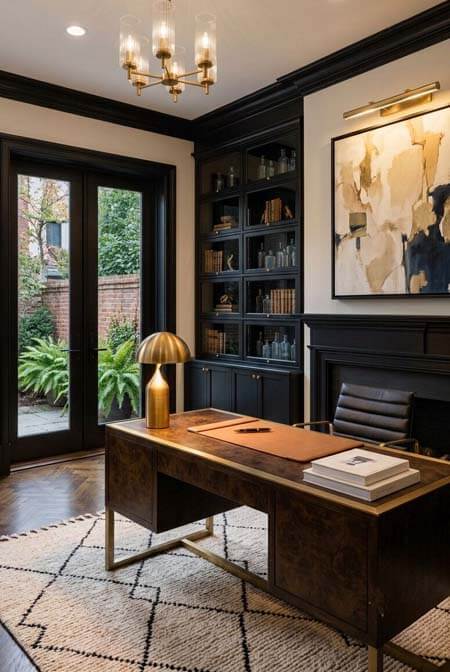 Black and white modern home office - AI-assisted image | Human-editedDark Brown or Black
If you like the look of stained wood but replacing your painted baseboards is not within your budget, you can paint your trim and moldings a brown color to give the feeling of a stained wood.
Dark brown trim looks good with light colored walls as well as dark colored walls.
Black is another option that is a bold choice for architectural trim and moldings that can have a very elegant and sophisticated look due to the high contrast.
Black trim looks good in modern as well as traditional homes.
Consider pairing bold black trim with crisp white elements for a high contrast aesthetic that is sure to be memorable!
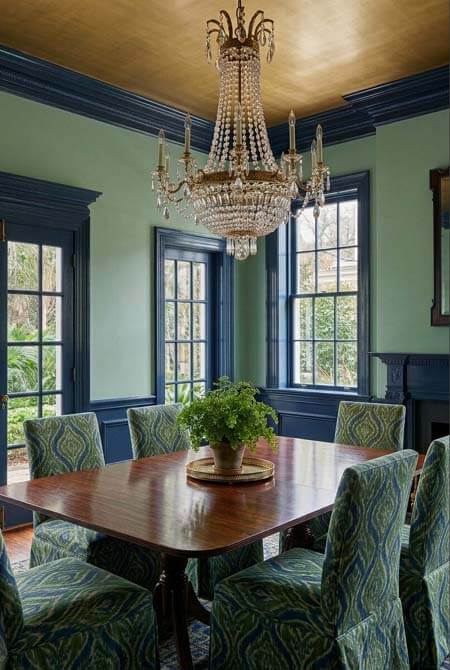 Blue and green dining room - AI-assisted image | Human-editedUnique Color
If you like to be different, experiment, and take chances with your home's decor, consider painting your architectural trim and moldings a bright color or a bold color that is unique.
Why be like everyone else?
You could pick a random color in your room's color scheme to paint your architectural trim in order to further reinforce your color scheme.
This will give you a one-of-a-kind look that nobody else has in their home.
For a more subtle bold color choice for your moldings, consider using a very dark color (such as navy or dark green) to paint your trim so that it almost looks like black at first glance.
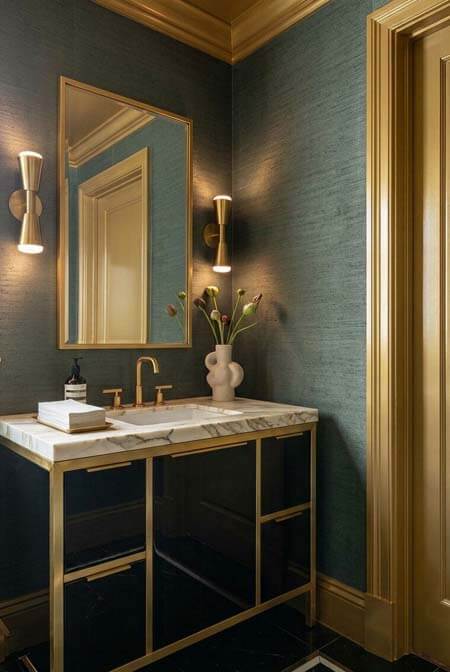 Bathroom with gold trim - AI-assisted image | Human-editedMetallic
If you like glitz and glam and sparkly things, consider painting your moldings a metallic color, such as metallic silver, gold, nickel, brass, bronze, or copper.
Metallic painted trim can be used in modern, contemporary, and traditional spaces.
Traditional spaces with metallic trim are typically ornate styled rooms, such as in a French Provincial style.
Modern spaces with metallic trim tend to be very minimal and glamorous with the metallic color repeated throughout the room on metal pieces as well as painted pieces.
You could even go a bit over-the-top and glitter paint your molding to be extra special.
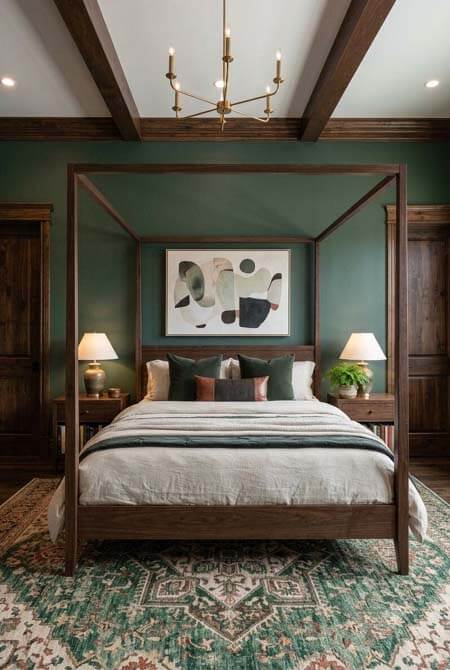 Bedroom with stained wood trim - AI-assisted image | Human-editedStained
For a more high end look, use stained millwork instead of painted millwork since stained millwork is made from more expensive lumber with a nice grain (painted millwork is typically made with cheaper lumber or wood composite products).
Homes with stained millwork often have ceiling beams that are also stained.
If you currently have stained trim but don't care for the look, consider having it restained a different color that you like better.
Stained trim often feels a bit overpowering, so feel free to use stained baseboards, window trim, door trim, and crown molding but paint your applied wall moldings the same color as your wall color.
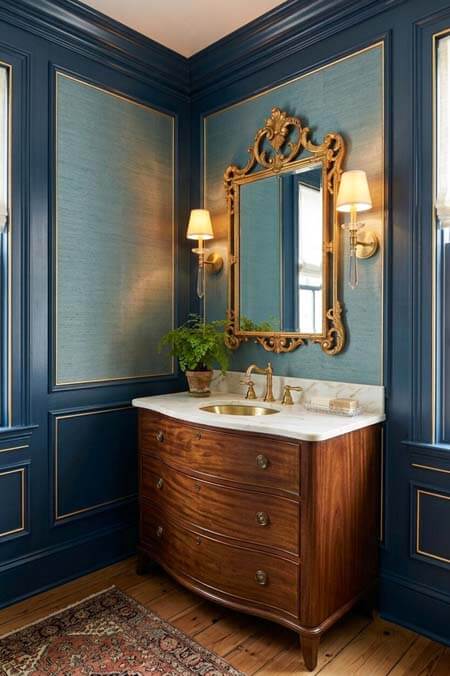 Shades of blue bathroom - AI-assisted image | Human-editedLighter or Darker Version of Your Wall Color
You can paint your trim color the same hue as your walls, but a little bit darker or lighter than the wall color.
A shade of a color is the color mixed with a little bit of black. A tint of a color is the color mixed with a little bit of white.
When choosing a color that is lighter or darker than your wall color, make sure that it is not just a tiny bit lighter or darker. You need it to be a lot lighter or darker so people can tell that it is a different color.
If you are looking at a paint color strip in a fan deck, choose a color that is at least 2 or more colors lighter or darker than your original color, not the adjacent color.
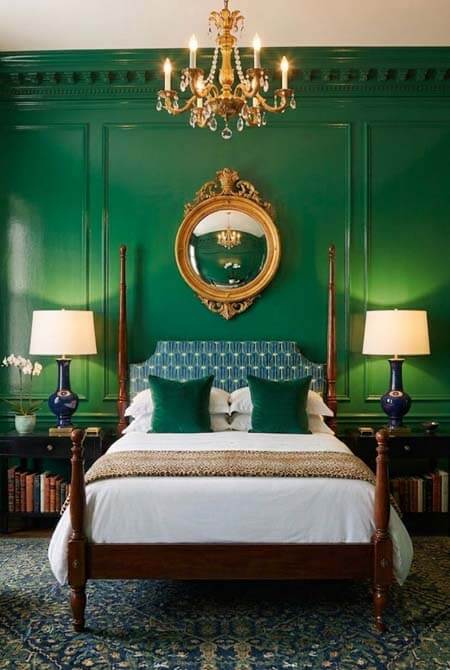 Green and blue bedroom - AI-assisted image | Human-editedWall Color
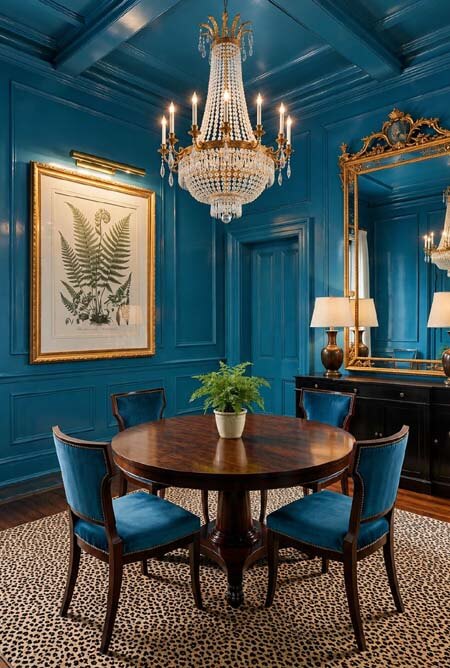
Your architectural trim can be painted the same color as your wall color for a streamlined aesthetic.
The interior design term for this is called color drenching.
You might choose to paint all of the trim on your walls the wall color or paint just the applied moldings on your wall your wall color but make your crown molding, door trim, and window trim a different color.
Even though you are using the same color of paint for your trim as your walls, you should not be using the exact same paint.
Trim paint should be glossier than wall paint. You might choose to use a flat, matte, or eggshell paint on your walls, but your trim will likely be a semi-gloss paint.
 Dramatic modern blue dining room - AI-assisted image | Human-editedTips
For a cohesive home, keep all of the moldings in adjacent rooms of your home the same color, however you can change the color of trim in rooms that have a door that can be closed.
If you want to be a bit daring with your millwork color, consider painting a small room or bedroom the daring color first, then move on to the larger rooms if you love the look.
Avoid updating part of the trim in your home to be a different style or color but keeping the older style and color in a different part of your home because it will make the older trim and color look extremely dated and out of place.
If you want to get an idea of how your home might look with a different color trim, consider uploading a picture of your home into an image editing software and ask it to give you an image of your room with different color trim.
Make sure to consider the sheen of your trim paint. Sheen refers to the glossiness. Most trim is painted in a semi-gloss paint, however you might choose a high gloss paint for added drama.